Chidinma Nwosu
November 2025
17 minute read
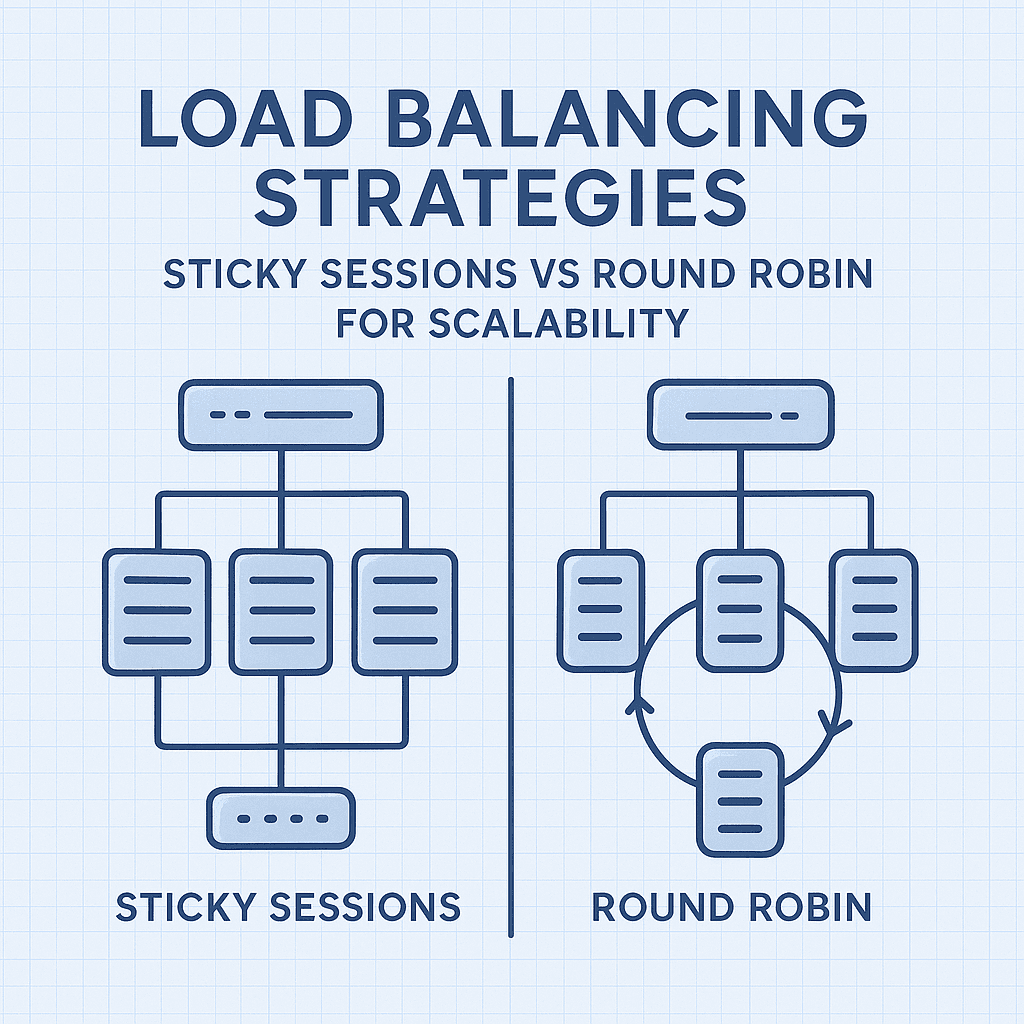
In the era of cloud computing and exponential user growth, scalability and high availability are non-negotiable requirements for any successful web application. A single server is rarely enough to handle peak traffic, leading to bottlenecks, slow response times, and catastrophic failures. The solution is load balancing—the art and science of distributing incoming network traffic across a group of backend servers, often referred to as a server farm or pool.
A well-chosen Load Balancing Strategy is the critical factor that determines how effectively your system handles millions of concurrent requests. Among the myriad of algorithms available, two foundational methods—Round Robin and Sticky Sessions (also known as Session Persistence)—represent a crucial architectural decision point. While Round Robin prioritizes even distribution, Sticky Sessions prioritize user experience and the maintenance of state. Understanding the trade-offs between these Load Balancing Strategies is key to optimizing performance, cost, and resilience.
This comprehensive article will provide a deep dive into both Sticky Sessions and Round Robin for scalability, detailing their mechanisms, practical implementations, and the specific scenarios where one strategy dramatically outperforms the other. We will also explore modern best practices that often mitigate the need for traditional sticky sessions.
The Round Robin algorithm is arguably the simplest and most intuitive of all Load Balancing Strategies. Its mechanism is straightforward: it cycles through the list of available backend servers in order, sending the first request to server 1, the second to server 2, and so on. Once it reaches the end of the list, it loops back to the beginning.
Imagine a line of users waiting for service at a bank with multiple tellers (servers). A clerk (the load balancer) directs the first person to teller A, the second to teller B, the third to teller C, and the fourth back to teller A. This cyclical distribution ensures every server receives an equal number of requests over time. This makes Round Robin an excellent mechanism for traffic distribution.
Fair Distribution: Guarantees that all servers receive an almost identical number of requests.
Low Overhead: Requires minimal computation by the load balancer, making it extremely fast.
Simplicity: Easy to implement and manage, often the default setting in many load balancing systems (e.g., NGINX, HAProxy).
While simple, basic Round Robin has a significant flaw related to unequal server capability and request complexity. It treats all requests and all servers equally:
Uneven Load: If server A is older and slower than server B, or if one request takes 1 second and the next takes 10 seconds, the load will not be truly balanced, leading to server A being overloaded.
No Session Awareness: This is the most critical issue. Because each subsequent request from the same user can go to a different server, applications that store session state (like user login data, shopping cart contents, or partially completed forms) directly on the server will fail. The user will lose their session data.
To address the uneven load issue, a variation called Weighted Round Robin is often used, where faster or more capable servers are assigned a higher weight and receive a proportionally larger share of the traffic.
The necessity of maintaining a continuous user experience, especially in applications that store session information on the server (known as stateful applications), gives rise to the Sticky Sessions strategy. This technique ensures that all requests from a specific client are directed to the same backend server for the duration of their session.
Sticky Sessions achieve persistence by tracking a specific client identifier and mapping it to a specific backend server. Common methods include:
Cookie-Based Persistence: The load balancer intercepts the first request, selects a server, and adds a small cookie to the response. This cookie contains the identifier of the chosen server. For all subsequent requests, the client sends this cookie, and the load balancer routes the request accordingly.
Source IP Hashing: The load balancer uses a hash of the client's source IP address to determine which server to use. This is simpler to implement as it doesn't require cookie management, but it can be problematic if multiple users share the same source IP (e.g., users behind a large corporate NAT/Proxy).
While Sticky Sessions solve the state management problem, they can significantly undermine the primary goal of load balancing—the even distribution of traffic. This is their core weakness for horizontal scalability:
Uneven Load Distribution: A popular user (an influencer or a bot) can generate a high volume of traffic, all of which is directed to a single server due to the session stickiness. This can lead to that specific server being overloaded while others remain idle.
Poor Fault Tolerance: If the server hosting a user's session fails, that user's session data is lost, and they must start over. The load balancer can redirect the user to a new server, but the session state stored on the failed server is gone. This is a major availability risk.
Hindered Scaling: When you add a new server to the pool, it will only start receiving new client sessions. Existing sticky sessions will continue to pound the older servers, slowing down the time it takes for the new server to achieve a truly balanced load.
The choice between Sticky Sessions and Round Robin fundamentally depends on whether your application is stateful or stateless.
Round Robin is the preferred choice for stateless architectures—where the server itself holds no persistent user data between requests. The server simply processes the request using data provided in the request (cookies, tokens, query parameters) or from a shared data store (database, cache). Examples include RESTful APIs, serving static assets, or microservices that rely heavily on a centralized session store (like Redis or Memcached).
The industry consensus for highly scalable systems is to strive for a stateless architecture. The goal is to eliminate the need for Sticky Sessions altogether, which allows you to utilize highly efficient, non-persistent algorithms like Round Robin or, even better, Least Connections.
The most effective way to eliminate server-side session state is by moving the state out of the application server's memory and into a highly available, external store. This strategy immediately enables pure Round Robin balancing.
Centralized Caching (Redis/Memcached): Session IDs are passed in a cookie, and the application server retrieves the corresponding session data from a fast, shared key-value store like Redis. Any server can handle the request.
Database Storage: Less performant than caching, but highly durable. The session ID points to a record in a shared database.
Client-Side Sessions (JWT/Cookies): All necessary, non-sensitive session data is encrypted and stored in a client cookie or a JSON Web Token (JWT). The server is completely stateless and validates the token on every request.
Once you achieve statelessness, you can employ more intelligent Load Balancing Strategies than simple Round Robin to maximize efficiency.
Least Connections: The load balancer routes the request to the server with the fewest active connections. This is superior to Round Robin because it considers the server's current load, ensuring a truly even distribution of concurrent workload.
Least Time: A highly advanced strategy (used by Amazon ELB or AWS ALB) that chooses the server with the lowest combination of latency and fewest active connections. It accounts for both speed and load.
Hash Algorithms (e.g., URL Hashing): Routes traffic based on a hash of the requested URL. This is useful for improving cache hit rates by ensuring requests for the same content always go to the same server.
Selecting the right algorithm is a decision that impacts availability, scalability, and user experience. Follow these guidelines for optimal deployment:
Prioritize Statelessness: Always design new applications to be stateless. This is the number one best practice for achieving elastic scalability and high availability. It allows you to use non-sticky methods.
Default to Least Connections: For stateless microservices and APIs, Least Connections is generally the superior default over Round Robin, as it dynamically adapts to varying request times and server health.
Use Sticky Sessions Only When Necessary: If forced to use Sticky Sessions, set a short timeout for the stickiness (e.g., 5-10 minutes). Implement a backup mechanism to restore or recreate session data if the assigned server fails.
Monitor Server Health: Regardless of the algorithm, implement continuous health checks (e.g., HTTP 200 OK) so the load balancer can immediately remove failed or slow servers from the rotation, thus improving reliability.
The debate between Sticky Sessions and Round Robin is a microcosm of modern software architecture: the choice between convenience/legacy support (stickiness) and pure, unconstrained scalability (non-persistent methods). While Round Robin offers basic, fair distribution and low latency, it is only truly effective in a stateless environment.
The most robust and future-proof approach is to design stateless applications and use a dynamic Load Balancing Strategy like Least Connections. If you must use Sticky Sessions to maintain state, recognize the trade-off: you are sacrificing some degree of scalability and fault tolerance for architectural simplicity. Ultimately, mastering these Load Balancing Strategies is central to building resilient, high-performing systems that can handle any surge in demand.
The biggest downside is uneven load distribution. If one user's session generates significantly more traffic than others (a 'power user'), that user's assigned server can become overloaded, while other servers remain idle. This fundamentally defeats the purpose of effective load balancing.
No. Round Robin is completely unsuitable for stateful applications where session data is stored only on the server. Since a user’s requests will be sent to different servers, the user will repeatedly lose their session data (e.g., login status or shopping cart items) and be forced to start over.
The Least Connections algorithm is generally superior because it is dynamic. It routes traffic based on the current number of active requests being handled by each server, whereas Round Robin is static and only counts the number of total requests. Least Connections ensures a more equitable distribution of current workload.
Externalizing session state means moving the user session data (like login info or cart items) from the local memory of the application server to a separate, shared service, such as Redis, Memcached, or a database. This allows any server behind the load balancer to handle any user request, enabling the use of non-sticky, highly scalable algorithms like Round Robin or Least Connections.